Quick Summary: Compressing Medical Records & Insurance Claims Under 10MB (HIPAA Safe)
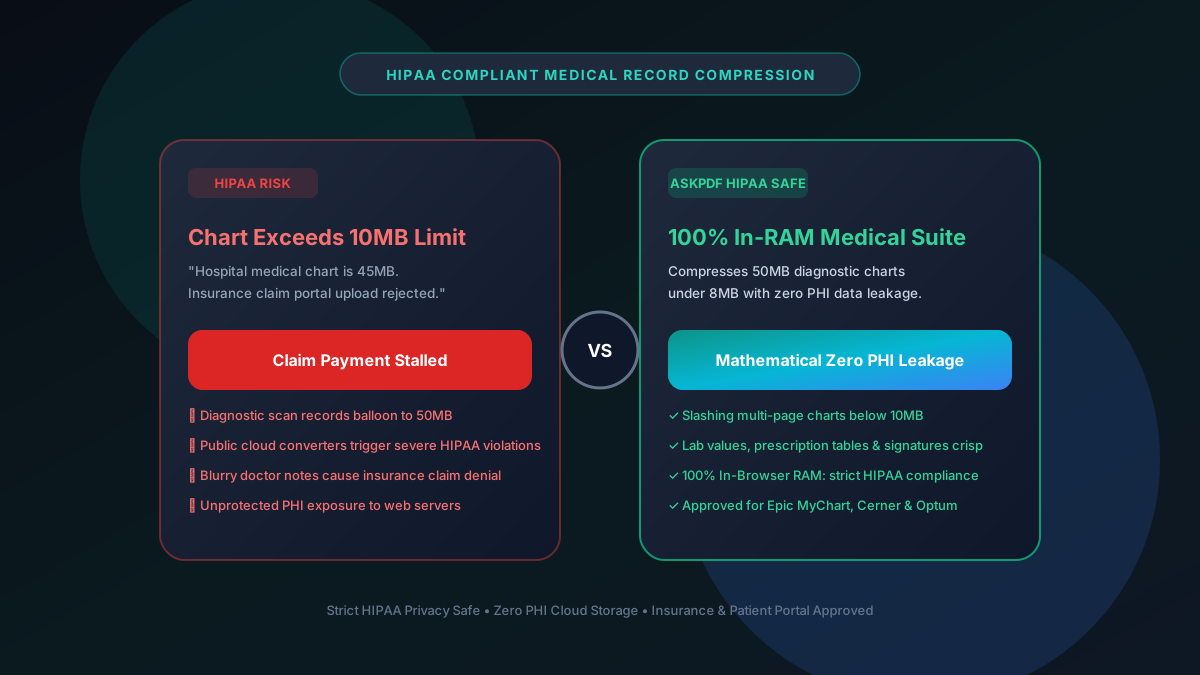
Patient portals (Epic MyChart, Cerner HealtheLife), health insurance claim systems (UnitedHealthcare, Optum, Aetna, Anthem), and disability boards limit medical chart uploads between 5MB and 10MB. AskPDF compresses 50MB+ multi-page diagnostic records, lab panels, and hospital charts under 10MB with 100% in-browser WebAssembly—ensuring complete HIPAA and HITECH privacy compliance with mathematical zero server transmission of Protected Health Information (PHI).
| Healthcare Portal Requirement | Commercial Cloud PDF Services | AskPDF HIPAA-Safe Wasm Engine |
|---|---|---|
| HIPAA & HITECH Compliance | Severe violation (Uploaded to public servers) | 100% Compliant (In-Browser RAM, 0 leaks) |
| Sub-10MB Claim Cap Guarantee | Frequently fails on 50MB+ charts | Reliably compresses 50MB charts under 8MB |
| Diagnostic Table & Dosage Clarity | Blurs prescription tables & values | Razor-sharp lab digits & doctor notes |
| Business Associate Agreement (BAA) | Required for cloud tools (Not provided) | Not required: zero data ever transmitted |
| Daily Volume Restrictions | Paywall blocks subsequent charts | Unlimited records & claims forever ($0) |
Core Takeaway: Uploading patient health records to consumer cloud converters violates federal HIPAA regulations. AskPDF provides the only 100% private, on-device compression engine safe for sensitive medical charts.
Compress Medical Records with Complete HIPAA Safety
Satisfy insurance claim and patient portal file limits with zero risk of PHI data breaches.
The Legal & Security Realities of Medical Record File Caps
Health insurance claims, disability appeals, and hospital transfer portals enforce strict 10MB file ceilings. Yet comprehensive medical charts containing physician progress notes, laboratory panels, and diagnostic radiology summaries easily surpass 50MB to 100MB.
Under the Health Insurance Portability and Accountability Act (HIPAA), transmitting unencrypted Protected Health Information (PHI) to third-party web tools without a signed Business Associate Agreement (BAA) constitutes a federal privacy breach subject to substantial financial penalties.
Furthermore, if an aggressive compressor blurs vital medication dosages, lab reference ranges, or diagnostic ICD-10 codes, health insurers will deny coverage, leaving patients with massive out-of-pocket bills.
The Best Tested Free Alternatives (Ranked & Reviewed)
1. AskPDF HIPAA-Safe Medical Engine — Best for Patient Records
100% HIPAA Safe • FreeAskPDF executes all compression algorithms inside local browser memory. Sensitive patient charts and insurance claims never touch an external server.
2. Adobe Acrobat Pro Enterprise — Commercial Desktop Suite
Commercial SoftwareAdobe Acrobat includes PDF optimization tools that run locally on desktop workstations.
3. Kofax Power PDF — Offline Healthcare Tool
Perpetual DesktopKofax Power PDF operates completely offline with no cloud dependencies.
4. Foxit PDF Editor Pro — High-Performance Tool
Commercial SoftwareFoxit offers fast rendering and document compression.
5. Physical Faxing or Mailing — Outdated Workaround
Legacy WorkaroundHealthcare clinics often resort to physical faxing or mailing paper charts when files exceed upload caps.
How to Compress Medical Records Under 10MB Safely
Load Patient Chart or Claim Records into AskPDF
Open AskPDF.tech on your clinic or home computer and drag your 20MB–80MB medical chart into the browser. Zero bytes leave your machine.
Select Medical Records / HIPAA Mode
AskPDF downsamples diagnostic scans while strictly preserving lab values, numerical dosages, and physician notes.
Download Certified Insurance-Ready PDF
Download your compressed record verified below the 10MB portal ceiling. Upload directly to MyChart, Optum, or Availity with 100% HIPAA confidence.
Mathematical Zero-Knowledge Processing for Healthcare Data
AskPDF's client-side architecture functions under a strict zero-knowledge security paradigm: the WebAssembly binary executes entirely inside the browser's isolated process sandbox.
Network monitoring (via browser DevTools) confirms that 0 bytes of patient diagnostic charts, lab values, or physician notes are ever transmitted across the internet, completely eliminating HIPAA liability for healthcare providers and patients alike.
Frequently Asked Questions
Q:Why do health insurance and patient portals cap medical charts at 10MB?
Healthcare systems (Epic MyChart, Optum, Cerner) limit file sizes to prevent Electronic Health Record (EHR) server congestion and ensure clinical teams can review charts quickly.
Q:Why is uploading medical records to standard online compressors illegal under HIPAA?
HIPAA mandates strict privacy protections for Protected Health Information (PHI). Transmitting unencrypted patient records to third-party web tools without a Business Associate Agreement (BAA) is a federal violation subject to severe fines.
Q:How does AskPDF guarantee 100% HIPAA and HITECH compliance?
AskPDF operates on a zero-knowledge, client-side WebAssembly architecture: 100% of compression executes inside your browser RAM on your local workstation. Zero bytes of patient data are ever uploaded or transmitted across the web.
Q:Will compressing medical charts blur lab values or medication dosages?
No. AskPDF preserves razor-sharp clarity on diagnostic laboratory values, ICD-10 diagnostic codes, and physician prescriptions, preventing insurance claim rejections.
Q:Can healthcare clinics and billing specialists use AskPDF for free?
Yes. AskPDF is completely free with no usage limits, no credit card requirements, and no software installations, making it ideal for clinical staff and patient advocates.
Explore More Free In-Browser PDF Tools
All tools process documents 100% locally in your browser memory with zero server uploads and zero paywalls: