1. The Critical Imperative for PDF Encryption
In today's interconnected digital economy, the Portable Document Format (PDF) is the undisputed lingua franca for official records. Every single day, hundreds of millions of tax filings (IRS Forms 1040 and W-2), merger and acquisition contracts, patient medical histories, bank account statements, and court discovery exhibits are generated, emailed, and archived as PDFs.
Yet, the vast majority of these documents travel across the public internet completely unencrypted.
A common misconception among business professionals is that standard email transmission (over SMTP with TLS) guarantees complete security. In reality, TLS only encrypts the connection between your device and your email provider's mail transfer agent (MTA). Once your email leaves that server, it traverses multiple intermediate relay hops, third-party mail servers, corporate archiving gateways, and cloud spam filtering caches—where attachments are stored as cleartext raw data.
According to IBM Security's Cost of a Data Breach Report, the global average cost of a data breach has surged to $4.88 million. In highly regulated sectors like healthcare and financial services, statutory penalties under the Health Insurance Portability and Accountability Act (HIPAA), the European Union’s General Data Protection Regulation (GDPR), and the Gramm-Leach-Bliley Act (GLBA) mandate severe financial fines for transmitting unencrypted Personally Identifiable Information (PII) or Protected Health Information (PHI).
Document-level encryption—specifically locking the internal object streams of the PDF file itself with standardized cryptography—guarantees that even if an email is intercepted, a cloud storage bucket is misconfigured, or a laptop is stolen, the underlying document contents remain an indecipherable scramble of pseudorandom ciphertext.
2. 256-Bit AES vs. Legacy 128-Bit & 40-Bit RC4
Not all password-protected PDFs offer the same level of security. The PDF specification (maintained by the International Organization for Standardization as ISO 32000) has evolved through multiple encryption revisions over the past three decades. Understanding these differences is the dividing line between real cryptographic security and false comfort.
| Encryption Standard | ISO / Acrobat Version | Key Space | Vulnerability Status | Brute-Force Feasibility |
|---|---|---|---|---|
| 40-Bit RC4 (Rev 2) | PDF 1.1 / Acrobat 3.0 | 240 keys | Trivially Broken | < 3 seconds on a smartphone |
| 128-Bit RC4 (Rev 3) | PDF 1.4 / Acrobat 5.0 | 2128 keys | Deprecated / Flawed | Vulnerable to known RC4 bias attacks |
| 128-Bit AES (Rev 4) | PDF 1.6 / Acrobat 7.0 | 2128 keys | Acceptable Legacy | Resistant to direct key exhaustion |
| 256-Bit AES (Rev 6) | ISO 32000-2 (PDF 2.0 / Acrobat X+) | 2256 keys | Gold Standard | Mathematically Uncrackable |
Early versions of the PDF format used RC4 stream ciphers. In 1996, the United States government enforced export restrictions limiting encryption to 40-bit keys. A 40-bit key space contains only 1.09 trillion possibilities, which modern graphics cards can exhaust in fractions of a second using tools like John the Ripper or Hashcat.
Later, 128-bit RC4 was adopted, but cryptanalysts proved that RC4 suffers from severe pseudo-random keystream biases (Fluhrer-Mantin-Shamir attacks and Bar Mitzvah attacks).
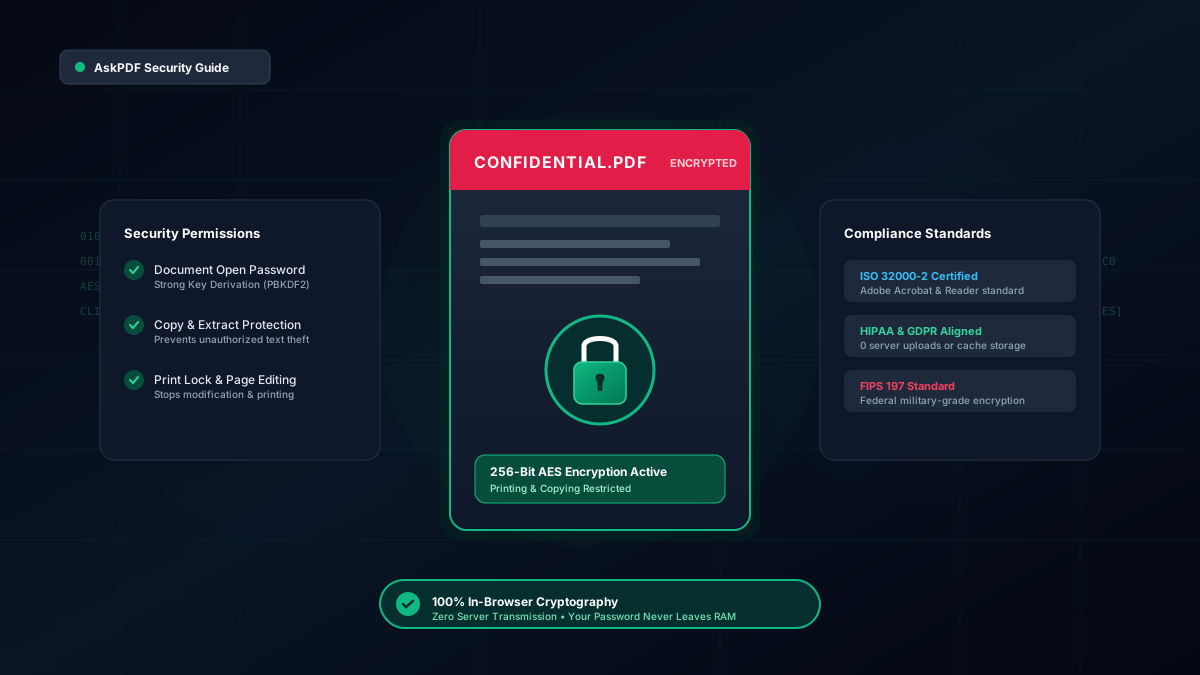
With the introduction of ISO 32000-2 (PDF 2.0), the document security standard mandated 256-bit Advanced Encryption Standard (AES-256) utilizing the Revision 6 Standard Security Handler. In this architecture:
- Key Derivation Function: User passwords are not hashed with simple, fast algorithms like MD5 or single-iteration SHA-1. Instead, they pass through a high-cost key derivation process (such as PBKDF2 or SHA-256 with thousands of rounds and cryptographic salt) to thwart GPU-accelerated dictionary attacks.
- Cipher Mode: All text streams, vector paths, embedded raster photographs, and document metadata structures are encrypted using AES in Cipher Block Chaining (CBC) mode with random Initialization Vectors (IVs) for every object.
- Immense Key Space: A 256-bit key provides \(2^256 \approx 1.1579 \times 10^77\) unique combinations. To put this in astronomical perspective, that number exceeds the estimated total number of atoms in the entire observable universe (\(\approx 10^80\)). Even if all the computing clusters on Earth were pooled together, brute-forcing a 256-bit AES key would take billions of times longer than the current age of the universe.
3. User (Open) vs. Owner (Permissions) Passwords
A persistent source of confusion in PDF management is the structural difference between a User Password (also known as a Document Open Password) and an Owner Password (also known as a Permissions or Master Password).
The User Password is the primary cryptographic gatekeeper. When set, the underlying content streams of the PDF are completely scrambled. Any recipient attempting to view the file in Adobe Acrobat, Apple Preview, Google Chrome, or a mobile phone viewer is prompted for this password.
The Owner Password controls administrative privileges and behavioral restrictions. It allows the creator to specify granular rules, such as disallowing high-resolution printing, disabling text copying/extraction, or locking form-field editing.
pdf2text or qpdf) in milliseconds. True confidentiality always requires setting a User (Open) Password.4. The Cloud Upload Trap: Why Online Lockers Expose Data
When searching Google for "password protect PDF free", millions of users land on conventional cloud conversion portals (such as iLovePDF, Smallpdf, PDF2Go, and SodaPDF).
While these platforms are convenient, their underlying technical architecture introduces an enormous cybersecurity paradox: to protect your private file from unauthorized eyes, you must first upload your unencrypted document to a stranger's remote server.
The Hidden Attack Surface of Server-Side PDF Lockers
- •Cleartext In-Transit Exposure: Even over HTTPS, your unencrypted PDF is received by third-party web application load balancers, decrypted in their memory, and placed into shared task-queue worker instances (e.g., Redis or Celery).
- •Ephemeral Disk Caching: Most cloud utilities write incoming files to temporary server storage volumes (e.g. AWS EBS or S3 buckets) while processing. Although their privacy policies claim files are deleted after "1 to 2 hours", backups, crash dump logs, and orphaned files frequently persist indefinitely.
- •Third-Party Personnel Access & Subpoenas: Server administrators, database engineers, or external cloud hosting providers have root shell access to the infrastructure. Furthermore, foreign or domestic government agencies can subpoena server disk images without notifying you.
- •Regulatory Violation: Under HIPAA (Section 164.308) and GDPR (Article 28), uploading patient charts, payroll W-2s, or client tax returns to an unauthorized third-party processing vendor without an executed Business Associate Agreement (BAA) or Data Processing Addendum (DPA) constitutes an illegal data disclosure.
For legal departments, certified public accountants (CPAs), healthcare providers, and privacy-conscious individuals, uploading raw sensitive files to foreign servers is an unacceptable compliance risk.
5. AskPDF’s Client-Side Cryptographic Engine
AskPDF was engineered to eliminate this security vulnerability entirely. Instead of relying on centralized backend servers, AskPDF leverages modern browser execution environments—specifically WebAssembly (WASM) and the native Web Cryptography API (SubtleCrypto)—to run standard ISO 32000 cryptographic routines directly on your computer or smartphone.
Local Memory Buffer
When you drop a file into the tool, the browser reads it as an ArrayBuffer inside your system's private RAM. Not a single HTTP POST request is triggered.
Cryptographic Key Derivation
Your CPU runs PBKDF2/SHA-256 with a unique cryptographic salt generated via crypto.getRandomValues() to transform your password into a 256-bit binary key.
AES-256 Stream Cipher
Every cross-reference table, object stream, and content dictionary is transformed into AES ciphertext. The resulting encrypted PDF is output directly as a local Blob download.
F12 → open the Network tab → encrypt any PDF. You will observe exactly 0 outbound bytes.6. High-Stakes Use Cases: Legal, Healthcare, Finance & Tax
Password protecting documents is not merely an optional best practice; for many industries in the United States, it is a strict statutory or contractual obligation:
Privileged Discovery & Settlement Pacts
Attorneys transmitting deposition transcripts, expert witness reports, or confidential settlement terms must safeguard attorney-client privilege. Encrypting PDFs ensures that inadvertent email CCs do not waive evidentiary privilege under Federal Rule of Evidence 502.
Tax Returns (1040/W-2) & Audits
Under IRS Publication 4557 (Safeguarding Taxpayer Data), tax preparers are legally required to encrypt all electronic records containing client Social Security numbers, bank routing details, and taxable income figures before emailing.
HIPAA Protected Health Information (PHI)
Medical records, diagnostic imaging reports, and billing statements emailed to patients or specialists must adhere to the HIPAA Security Rule (45 CFR § 164.312). On-device 256-bit AES protection guarantees strict adherence without risking cloud data exposure.
Cap Tables, Pitch Decks & Executive Payroll
Internal payroll rosters, capitalization tables, board resolutions, and intellectual property patent disclosures sent to prospective investors or external directors demand impenetrable file-level access controls.
7. The Science of Password Entropy & Brute-Force Timelines
While 256-bit AES is mathematically impenetrable at the cipher level, encryption is only as secure as the entropy of the password chosen by the human user.
If a user locks a document with a predictable 6-character password like secret or 123456, an attacker doesn't need to break the AES cipher—they simply test millions of dictionary words and common combinations every second against the PBKDF2 hash.
| Password Type & Example | Character Pool | Entropy | Time to Crack (Modern GPU Rig) | Security Rating |
|---|---|---|---|---|
| apple1 (6 chars) | Lowercase + Numbers | ~31 bits | < 1 Second | Compromised |
| P@ssw0rd! (9 chars) | Upper/Lower/Symbol | ~45 bits | 12 Minutes (Dictionary Rule) | Weak |
| Tr0ub4dor&3 (11 chars) | Complex Alphanumeric | ~68 bits | 3 Years | Moderate |
| correct-horse-battery-staple | 4-Word Diceware Passphrase | ~80 bits | 550 Million Years | Fortress Grade |
The Passphrase Advantage: As demonstrated by cryptographic researcher Bruce Schneier and the XKCD entropy model, four or five randomly chosen dictionary words separated by hyphens (e.g. orbital-falcon-copper-velvet) produce dramatically higher entropy than shorter "complex" strings with random numbers and punctuation, while remaining effortless for humans to memorize and transcribe over phone calls.
8. Step-by-Step Walkthrough: Encrypting in 10 Seconds
Here is the exact step-by-step process to lock your confidential document on AskPDF Protect:
Load Document into Browser Sandbox
Open AskPDF Protect and drop your PDF into the interactive zone. The browser allocates an isolated memory pointer; zero data is transferred over the wire.
Define Document Open Password & Permissions
Type a strong passphrase. You can confirm password accuracy using the visibility eye toggle. Optionally configure permission flags to restrict content copying or printing.
Execute On-Device 256-Bit AES Encryption
Click Protect PDF. Within 1 to 2 seconds, your device's multi-core CPU processes every byte through WebCrypto AES-256 routines, generating a brand-new encrypted ISO 32000 PDF file.
Download & Verify Password Lock
Click Download Protected PDF. Before transmitting the file to your client or counterparty, double-click the downloaded file on your computer to verify that your PDF viewer prompts for the password.
9. Out-of-Band Sharing: The Golden Rule of PDF Security
You have now protected your PDF with impenetrable 256-bit AES encryption. However, the most sophisticated cryptography in the world is instantly nullified if you commit the most common error in digital communication: sending the password in the exact same email as the encrypted file.
If an attacker compromises your email account or intercepts your unencrypted SMTP relay traffic, they have access to both the lock and the key simultaneously.
The Out-of-Band (OOB) Transmission Protocol
In information security, out-of-band communication means delivering information across two completely separate, independent networks.
10. Cross-Platform Compatibility & Recovery Realities
When distributing encrypted files to diverse external clients, technical friction is a major concern. Will a Mac user using Apple Preview or an Android phone user be able to open the file?
Because AskPDF adheres strictly to the official ISO 32000 PDF Standard, files encrypted through our tool require zero specialized plugins, third-party software, or proprietary keys. They open flawlessly across:
- Apple Ecosystem: Native macOS Preview, iOS Files app, Safari, and iPadOS.
- Microsoft Windows: Microsoft Edge PDF Viewer, Adobe Acrobat Reader, Foxit Reader.
- Google Android: Google Drive PDF Viewer, Chrome mobile, Files by Google.
- Linux: Okular, Evince, and Chromium.
True, standards-compliant 256-bit AES encryption has zero backdoors, master recovery keys, or bypass mechanisms. AskPDF does not store your files, does not log your keystrokes, and cannot "reset" a lost password. If you lose or forget the password, the document cannot be decrypted by us, by Adobe, or by law enforcement. Always record passwords in an enterprise password manager (such as 1Password, Bitwarden, or Apple Keychain).
11. Frequently Asked Questions
Can an online PDF locker steal or view my confidential documents?
If you use traditional cloud-based PDF tools, your unencrypted file is transmitted across the internet and stored on remote servers where it could be logged, analyzed, or compromised in a data breach. AskPDF solves this vulnerability completely: all 256-bit AES encryption algorithms execute locally inside your web browser's WebAssembly sandbox. Not a single byte or password ever leaves your physical device.
What is the difference between 256-bit AES and legacy 128-bit RC4 encryption?
Legacy 40-bit and 128-bit RC4 encryption schemes date back to early Acrobat versions and can be broken in minutes or hours using modern GPU-accelerated brute-force tools (such as Hashcat). In contrast, 256-bit AES (Advanced Encryption Standard, specified in ISO 32000-2 / PDF 2.0) has 2^256 possible key combinations—a number so vast that all the world's supercomputers combined could not brute-force it in trillions of years.
What is the difference between a User Password and an Owner Password?
A User Password (also called an Open Password) is required to decrypt and view the document content. Without it, the file cannot be opened by any PDF reader. An Owner Password (also called a Permissions Password) restricts specific actions—such as printing, copying text, or modifying pages—while allowing authorized users to view the file.
What happens if I forget the password I set on my encrypted PDF?
Because AskPDF uses authentic, mathematically rigorous 256-bit AES encryption with zero backdoors, there is no master reset key, recovery password, or administrative bypass. If you forget your password, the data inside the file cannot be recovered. We strongly recommend storing your passwords in a reputable password manager.
Will my password-protected PDF open correctly on iPhones, Android, Mac, and Windows?
Yes. AskPDF outputs standard ISO 32000-compliant encrypted PDF documents. They natively prompt for password entry on Apple iOS Files / Preview, Android Google PDF Viewer, Adobe Acrobat Reader, Microsoft Edge, Google Chrome, and macOS Preview without requiring proprietary software.
How should I securely send the password to the recipient of the protected PDF?
Never send the password in the exact same email thread or message as the attached PDF. Use an 'out-of-band' communication channel: send the encrypted PDF via email, and text or voice-call the password via an encrypted messaging app (such as Signal or WhatsApp) or a one-time secret sharing link.